The Keddah elephant drive
The Jungle BookThe Keddah elephant drive is a large-scale capture operation conducted in the Garo Hills by the Indian Government’s elephant department. It transforms a scattered herd of wild elephants into a controlled population: human crews drive the animals across difficult terrain, force them into a stockade, and use trained elephants such as Kala Nag to isolate and overpower the strongest captives. The operation is both a feat of coordinated knowledge and a system that converts animal strength, memory, and courage into government service.
Government Organization and Purpose
The drive belongs to a formal department of the Indian Government devoted to hunting, catching, breaking in, and distributing elephants for work. Elephants are strictly preserved, not simply because they are admired, but because the state requires a managed supply of powerful working animals. The Keddah therefore joins conservation to capture: wild elephants are protected as a resource and simultaneously removed from independent life whenever the administration needs trained animals elsewhere.
The operation depends on extended preparation rather than a single rush. For weeks, men cautiously drive scattered elephants across the hills until a herd of forty or fifty wild animals has been gathered and forced into the final stockade. The terrain, weather, and movement of the herd are part of the labor. Little Toomai delights in bridle paths that only an elephant can use, valleys, distant browsing herds, sudden rain, misty mornings, and the slow advance that eventually becomes the violent culmination of the drive.
The Stockade and the Capture
The Keddah is a stockade made from heavy tree trunks lashed together. Once the wild elephants have entered, a large drop gate crashes down behind them. The enclosure becomes a scene of trumpeting, torchlight, ropes, crashing bodies, and attempts to break through the posts. The elephants fling themselves against the barriers, while men answer with shouts, flaring torches, and volleys of blank cartridges. Because the noise is overwhelming, the men must often communicate by signs rather than speech.
The crucial work is performed by trained elephants. At the word of command, Kala Nag enters the turmoil, chooses the largest and wildest tusker, and hammers and hustles him into submission while men mounted on other elephants rope and bind the smaller animals. The trained elephant is therefore not merely transport or equipment. He is an active combatant and an experienced specialist whose judgment and physical force make the capture possible.
Kala Nag’s shortened tusks are bound at their ends with copper bands, yet he can use the stumps more effectively than an untrained elephant can use full tusks. His strength is matched by tactical knowledge. He has learned how to approach a dangerous opponent, how to strike within the confined space of the stockade, and how to endure the confusion created by torches and moving bodies. His work makes the Keddah a contest between wild power and disciplined animal power rather than a simple human victory over nature.
Little Toomai and Animal Expertise
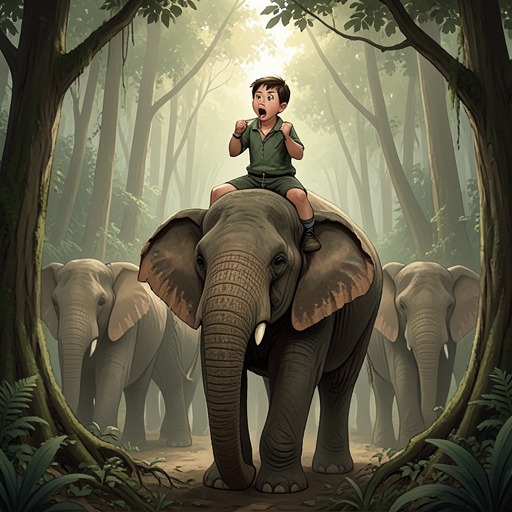
Little Toomai participates in the drive with unusual energy. He waves a torch, shouts encouragement, and climbs to the top of a trembling stockade post, where his sun-bleached hair makes him look almost like a goblin in the torchlight. Above the trumpeting and snapping ropes, his commands urge Kala Nag forward, warn him to be careful, and tell him to strike. The older elephant catchers notice the boy’s enthusiasm and acknowledge his usefulness.
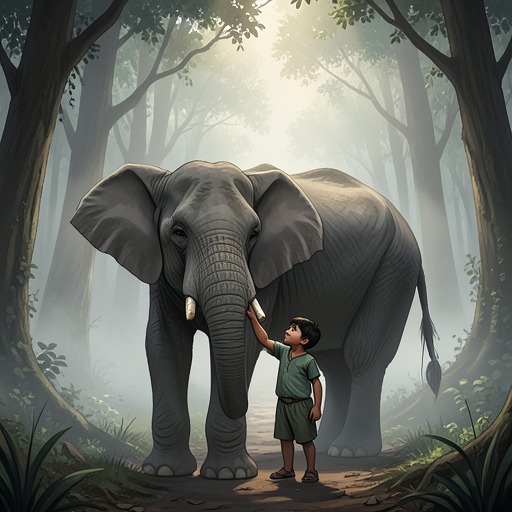
His involvement also exposes the danger of the work. During one capture, Little Toomai slips down among the elephants to lift the loose end of a rope for a driver struggling with a kicking calf. Kala Nag catches the boy in his trunk and hands him to Big Toomai, who immediately slaps him and returns him to the post. The incident shows both the intimacy and the peril of the human-elephant partnership: Kala Nag can rescue the child, but the same space remains a violent working ground in which a moment’s misjudgment can be fatal.
Little Toomai is drawn to the Keddah because it offers movement, uncertainty, and direct contact with wild elephants, whereas Big Toomai prefers secure brick elephant lines, regular roads, and predictable work. The boy’s excitement is not childish detachment from labor; it is a response to the skill, danger, and spectacle of the operation. His desire to belong to this work eventually carries him beyond the limits set by his elders and toward an experience that ordinary government service cannot explain.
Labor, Discipline, and Imperial Use
The drive rests on a long history of elephant labor. Kala Nag has served the Indian Government for forty-seven years after being captured at about twenty years of age, making him nearly seventy. He has carried tents weighing twelve hundred pounds, crossed the sea on a steam crane, transported a mortar through unfamiliar rocky country, and served in imperial campaigns. His memory reaches back before the Afghan War of 1842 and includes the Abyssinian War, the deaths of elephants from cold, epilepsy, starvation, and sunstroke, and later timber hauling in Moulmein.
This biography gives the Keddah a larger historical meaning. The operation does not end when a wild elephant is caught. Captured bodies may be trained for transport, construction, military supply, timber work, or further elephant catching. Kala Nag himself moves through these different assignments, carrying the physical cost of imperial expansion in his aged body. His service is praised through the language of experience and loyalty, but the same history records exhaustion, injury, discipline, and the deaths of other elephants.
The Keddah also resembles other systems in which animals are sorted according to human purposes. The seals at Novastoshnah are driven like sheep toward killing grounds and converted into seal-skin jackets, while elephants are driven toward stockades and converted into government labor. The two processes differ in outcome—one ends in slaughter, the other in training—but both organize animal movement through human institutions and assign value according to usefulness. The contrast makes the Keddah’s apparent admiration for elephant intelligence ethically complicated: the animals are recognized as skilled and powerful precisely as they are being brought under control.
The Secret Dance and the Drive’s Significance
The Keddah drive leads to the extraordinary discovery made by Little Toomai. After following Kala Nag through the night, the exhausted boy reaches Petersen Sahib’s camp and reports that he has seen the elephant dance. He arrives with Kala Nag, whose feet are sore, and collapses after declaring that he has witnessed the event. His testimony claims that elephants have trampled out a larger dance ground and that many tracks lead toward it, offering physical signs that can be checked rather than treating the experience as mere fantasy.
The discovery separates two kinds of knowledge. Human officials understand the drive through procedure, stockades, ropes, commands, and government service; Little Toomai, carried by Kala Nag, reaches a hidden space where elephants gather beyond human control. The capture operation is built on making wild elephants visible, concentrated, and governable. The dance represents the opposite movement: an animal society that remains difficult to observe and whose collective life is not organized for human use.
The Keddah therefore has a double significance. It is a practical technology of capture and a demonstration of trained elephant intelligence, but it also exposes the limits of human mastery. Men can drive elephants into a stockade, and Kala Nag can subdue a wild tusker, yet the elephants retain a world of movement, memory, and ceremony outside the enclosure. Little Toomai’s passage from the violent stockade to the hidden dance does not erase the machinery of government labor; it reveals that the animals subjected to that machinery possess forms of knowledge and collective life that the machinery cannot fully contain.